
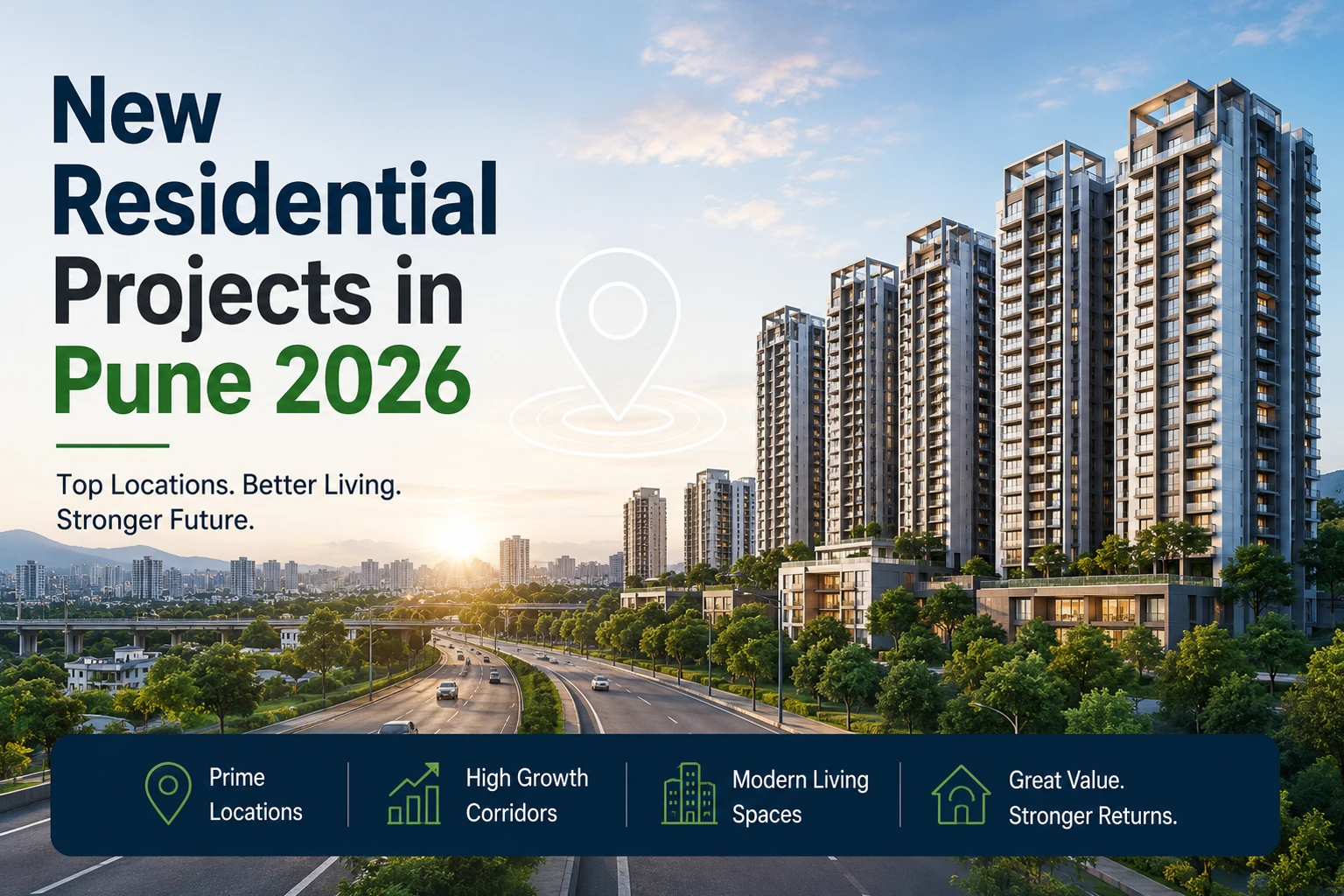
New Residential Projects in Pune 2026: Where to Buy and Why
By admin / July 10, 2026
Pune’s skyline keeps shifting, and so does the map of where people actually want to live. Between the IT boom in Hinjewadi and Kharadi, the Ring Road unlocking whole new suburbs, and Metro lines finally connecting east to west, 2026 has turned into one of the more interesting years for anyone tracking new residential projects in Pune. If you’re a homebuyer or investor trying to make sense of where the smart money is moving, here’s a grounded look at the market – the areas, the price bands, and what’s actually driving demand right now.
Why Pune’s Residential Market Is Still Heating Up in 2026
Pune’s growth story hasn’t changed much in its fundamentals – it’s still an IT and education hub with a much friendlier price tag than Mumbai or Bengaluru – but the geography of demand is shifting. The average property price across the city has climbed to roughly ₹12,000–13,000 per sq ft, with premium western pockets like Baner, Aundh, and Koregaon Park pushing past ₹14,000–22,000 per sq ft. Meanwhile, industry estimates suggest citywide rates could rise another 6–9% through the year, driven largely by three forces:
- Metro expansion — newly approved Lines 4 and 4A will link Kharadi, Hadapsar, Swargate, and Khadakwasla, adding over 30 km of transit and giving a real boost to areas along Solapur Road and Sinhagad Road.
- The Pune Ring Road — this is quietly becoming the biggest price catalyst in outer Pune, with projections of 20–25% appreciation along the corridor as it takes shape.
- Sustained IT and industrial employment — the Hinjewadi–Wakad belt in the west and the Kharadi–EON IT Park cluster in the east continue to anchor housing demand, while the Chakan–Talegaon industrial corridor is pulling first-time buyers north.
West Pune (Hinjewadi, Wakad, Baner) still accounts for the largest share of sales, but East Pune – Kharadi, Wagholi, and Hadapsar – is the fastest-growing corridor, posting the strongest year-on-year growth in average home values of any zone in the city.
East Pune: Where the Momentum Is Building
This is the corridor to watch. Kharadi continues to command premium rates (₹9,000–13,000 per sq ft) thanks to its IT-park density, while Wagholi and Hadapsar offer a genuinely different value proposition – entry prices around ₹5,000–8,000 per sq ft, with three-year appreciation already touching 16.5% in parts of Wagholi. Wagholi’s formal inclusion under PMC limits, and the fundamentals here are improving, not just the price tags.
Keshavnagar, adjoining Kharadi and Mundhwa, has also become a magnet for young IT professionals and NRI investors – particularly for compact, rental-friendly formats like studio apartments, given its walk-to-work distance from the Kharadi IT belt.
What’s Actually Driving New Launches Right Now
Developers across Pune are concentrating new launches in a handful of themes for 2026:
- Township-style developments with integrated amenities, especially around Hinjewadi and Life Republic-style formats.
- Mid-premium 2 & 3 BHK formats which Cushman & Wakefield’s Q1 2026 data pegs at roughly 46% of new supply — the segment developers are betting on most heavily.
- Rental-first micro-formats like studio and compact apartments in IT-adjacent locations such as Keshavnagar, aimed squarely at young professionals and investors chasing rental yield rather than end-use.
- A pullback from the sub-₹45 lakh segment as rising input costs push developers toward slightly higher price points even in "affordable" corridors.
This is where Esbee Realty’s own portfolio sits comfortably within the trend line. Adira in Wagholi (co-developed with Esbee Realty Developers) and 41 City Hub in Hadapsar are built for exactly the East Pune growth story outlined above – locations where infrastructure is catching up to demand rather than the other way around. And Socio Studios by Esbee in Keshavnagar taps directly into the rental-first, IT-professional demand that’s reshaping the studio apartment segment across Kharadi’s periphery.
Is Now a Good Time to Buy?
- For end-users: Metro-adjacent and IT-corridor locations continue to offer the most stable long-term value, but entry prices have moved up meaningfully over the past few years.
- For investors: Emerging corridors – Wagholi, Hadapsar fringe, Bhugaon, Ravet – offer the strongest appreciation upside precisely because infrastructure (Ring Road, Metro Phase 2, water schemes) hasn’t fully priced in yet.
- Do your diligence: Always verify MahaRERA registration, developer track record, and civic infrastructure status before committing.
FAQ –
Hinjewadi, Wakad, and Baner remain the strongest established corridors, while Kharadi, Wagholi, and Hadapsar in East Pune are seeing the fastest growth in both new launches and price appreciation.
Entry-level 1 and 2 BHK flats in emerging areas like Wagholi start around ₹5,000–6,000 per sq ft, while premium projects in Baner, Kharadi, or Koregaon Park can range from ₹14,000 to over ₹20,000 per sq ft.
Yes. Areas like Wagholi, Hadapsar, and Keshavnagar offer lower entry prices than the western IT corridor, along with improving infrastructure through the Ring Road, Metro Line 4/4A, and civic upgrades.
Reputed developers register all new residential launches under MahaRERA. Always verify a project’s RERA registration number before booking, regardless of how established the developer is.
Beyond price and amenities, verify the water supply arrangement, the property’s PMC/merged-village tax status, and how close the project genuinely is to planned Metro stations or Ring Road access points — brochure claims of "connectivity" don’t always hold up.
